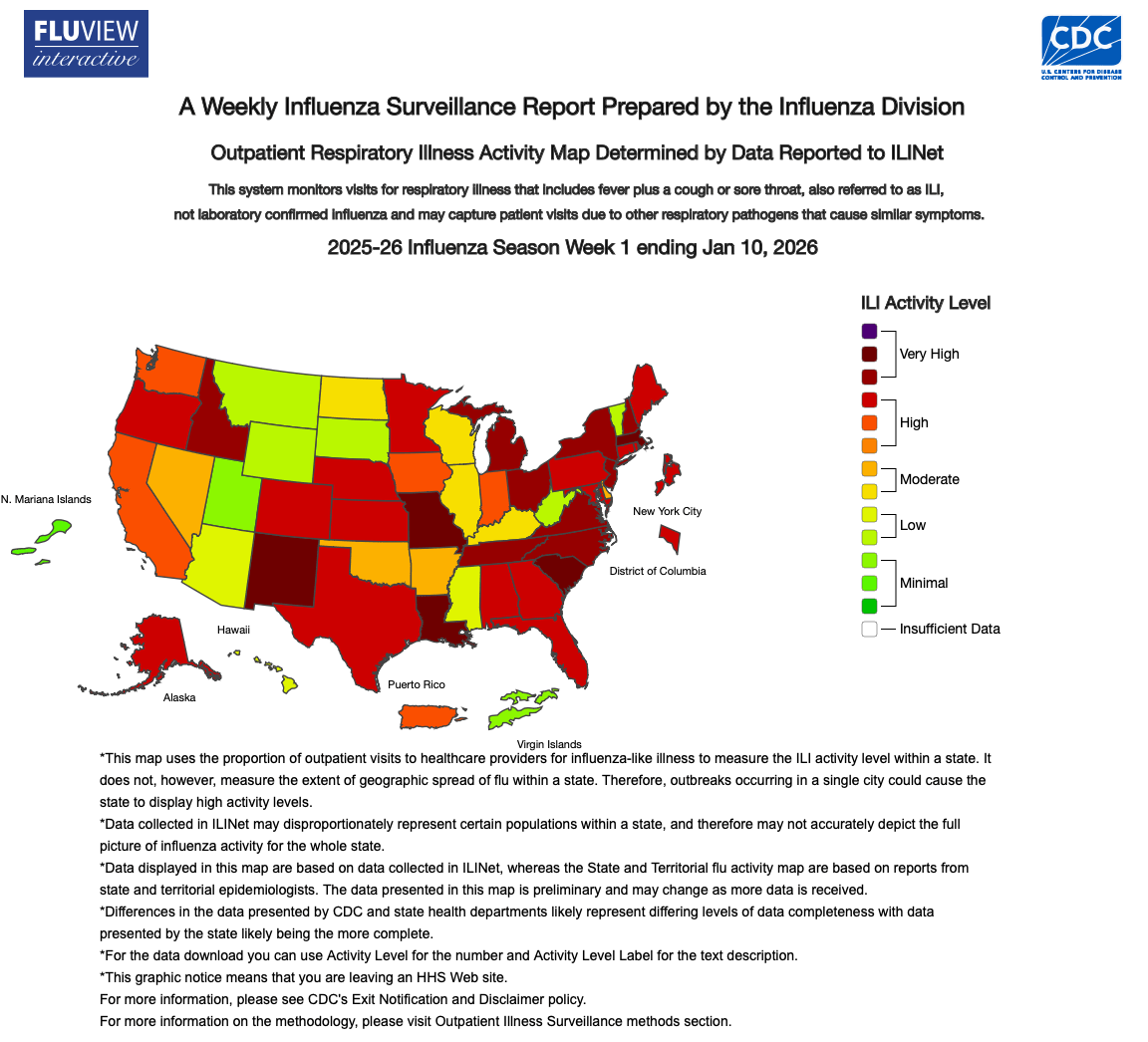
FLU Season 2026-Declining but Widespread
We saw several news updates on the 2025-26 Flu season and here is some of the latest information. This article from VOX is useful but if you are not a subscriber try a search mode.Why is this flu season so bad?
If this cold and flu season seem especially sneezy-coughy-fevery to you, it is not your imagination. Flu is surging in 45 states and outpatient doctor visits for flu-like symptoms are the highest they’ve been since we started keeping track of the data.
*Read in Vox: https://apple.news/A0GD0_g5BS0ew7wE0QwbI1g
- or search the Title
=======
One of our readers (LM) offered this concise commentary:
“Immunizations are down and 2 new strains have emerged. Historically flu vaccines are 30-60% effective. Far less than covid vaccines. Hence a population must maintain a high level of immunity to thwart the transmission to others ( herd immunity)
Influenza viruses come in many forms, but the ones that cause the most disease in humans are the flu A viruses H1N1 and H3N2, and influenza B. Subclade K is a variant of the H3N2 family of viruses, which can trigger more severe seasons and which seem to be harder on older people, who are among the most vulnerable to flu.
====
Very high activity States: NM,MO, LA,SC, MA etc.